The datalizard platform

What the datalizard Platform delivers
The datalizard platform connects existing applications so information remains consistent across systems. Instead of multiple versions of the same data, companies gain a single source of truth for planning, reporting, governance and AI-driven processes. This reduces the need for constant reconciliation and keeps information traceable across system boundaries. New requirements and data sources can be integrated without rebuilding established structures every time.
Evolve existing systems instead of replacing them
Most companies cannot simply start from scratch with their system landscape. Existing systems often contain years of configuration, business knowledge and integration work. The datalizard platform is designed to fit into what already exists. Core systems such as Abacus, Finnova, Microsoft Dynamics, custom databases and proprietary applications can be integrated and extended step by step without disrupting daily operations.
In practice, projects often begin where the pressure is greatest: data spread across multiple systems that does not always match, processes that require too much manual coordination, or new regulatory requirements that generate disproportionate effort. The datalizard platform helps companies build a shared data foundation across systems, bringing information from different applications together and placing it into a common business context.
A technical foundation for complex environments
Multi-tenancy, role-based access control, data versioning and audit trails are built into the datalizard platform from the ground up. These capabilities help companies control access, maintain traceability and reproduce information even years later. They provide the foundation needed for governance, compliance and AI applications that work with business-critical information.
Multilingual support and workflow orchestration are part of the core architecture. The platform remains deliberately open, allowing new systems to be added while existing applications continue to deliver value. Companies can extend their environment without having to start over whenever requirements change.
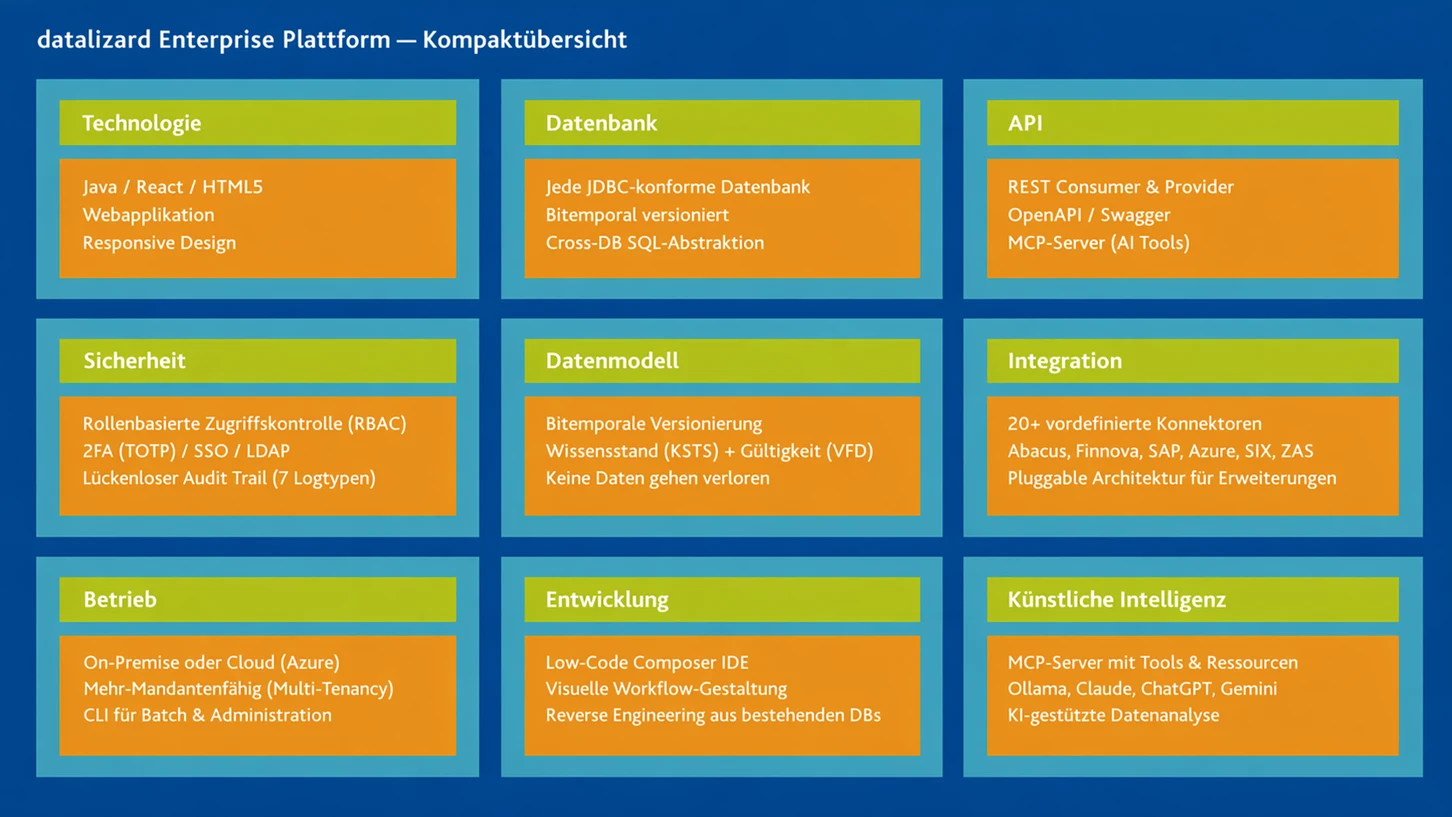
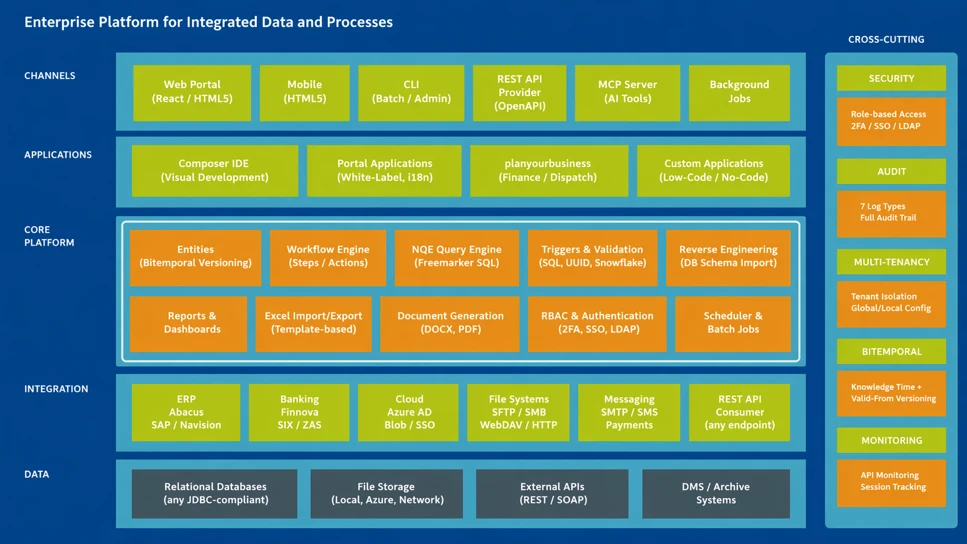
The following diagrams provide an overview of the technical architecture and show how data, processes, integrations and AI work together within the datalizard platform.
AI requires more than data access
Many companies have already gained their first experience with AI and discovered that the real effort rarely starts with the model itself. Once AI is expected to work with company data, simple access is no longer enough. Information must remain connected, traceable and governed. The datalizard platform integrates with existing systems and provides the foundation for AI to access information in a secure and controlled way.
A shared foundation for Management, Business and IT
Many projects do not fail because of technology. They fail because business teams and IT teams face different challenges. One side wants to move quickly, while the other is responsible for stability, security, performance and long-term maintainability. The datalizard platform is designed to bring these perspectives together. Business teams can actively shape processes while IT retains control over systems, integrations and governance. The result is a solution that works in day-to-day operations and can continue to evolve as requirements change.
Frequently Asked Questions about the Datalizard Platform
What does the datalizard platform do?
The datalizard platform connects existing systems, applications and data sources, harmonises data and makes it available in a controlled way. The result is a consistent data basis that can be used not only for reporting and analysis, but also directly in operational processes, automation and AI applications.
What is the difference between a data warehouse and the datalizard platform?
A data warehouse is primarily used to provide structured data for reporting, evaluation and analysis. It often answers the question: What happened?
The datalizard platform has a broader role. It connects data from different systems, processes and harmonises it, makes it available to applications and also supports operational processes, automation and AI applications. A data warehouse can be part of this type of architecture. The datalizard platform ensures that data remains consistent, controlled and usable across different applications and use cases.
How does the datalizard platform integrate with existing systems?
The datalizard platform is designed to fit into existing system landscapes. It connects existing data sources, applications and interfaces without requiring companies to replace their established IT landscape.
The platform supports databases, file formats, REST APIs and predefined connectors to systems such as Abacus, SAP, Microsoft Dynamics and Finnova. Existing applications can continue to be used, extended where needed and connected through shared data processes.
Do existing systems need to be replaced for the datalizard platform?
No. The datalizard platform complements existing systems rather than replacing them. Many companies have invested in applications, processes and individual configurations over many years. These investments should be preserved.
The platform comes in where data is currently distributed, inconsistent or only usable with considerable manual effort. It connects what is already there and turns it into a consistent data basis for reporting, planning, automation, business intelligence and data-driven applications.
What benefits does the datalizard platform offer companies?
The datalizard platform reduces data silos, manual reconciliation and conflicting information. It connects existing systems into a dependable data basis for reporting, planning, automation and AI applications.
Companies gain more transparency, better data quality and greater control over their data processes. Existing systems are not replaced, but connected and extended where it makes sense.
The architecture also remains flexible when AI is introduced. Companies do not have to bind data integration, business logic and AI permanently to a single provider or a specific model.
How does the datalizard platform support the use of AI?
AI applications only deliver reliable results if they can access the right data. What matters is not the largest possible amount of data, but the information that is relevant, current and approved for the specific use case.
The datalizard platform provides the basis for this. It connects data from existing systems, harmonises it and makes it clear where information comes from, how it has been processed and which rules apply to its use.
For controlled access by AI applications, Datalizard provides an MCP server. Through this server, selected information and functions from the datalizard platform can be made available to AI applications. This creates clear boundaries, defined roles and a dependable data basis for the responsible use of AI in the company.
How are data security, governance and traceability ensured?
The datalizard platform uses controlled access rights, clear data processes and traceable structures. Role-based permissions, authentication, audit trails and historisation help ensure that data is used securely and in line with regulatory requirements.
This makes it possible to trace which data is used, who has access and how information has been processed. This is important for reporting, business-critical processes, compliance and the controlled use of AI.
Which companies is the datalizard platform suitable for?
The datalizard platform is suitable for organisations with established system landscapes that want to make better use of their data across different applications.
Typical starting points include distributed data sources, manual reconciliation, Excel-based interim solutions or specialist applications that are not sufficiently connected. The platform is particularly relevant where existing systems should continue to be used, while transparency, data quality, automation and governance need to be improved.

Master Data Management

Not sexy, but profitable