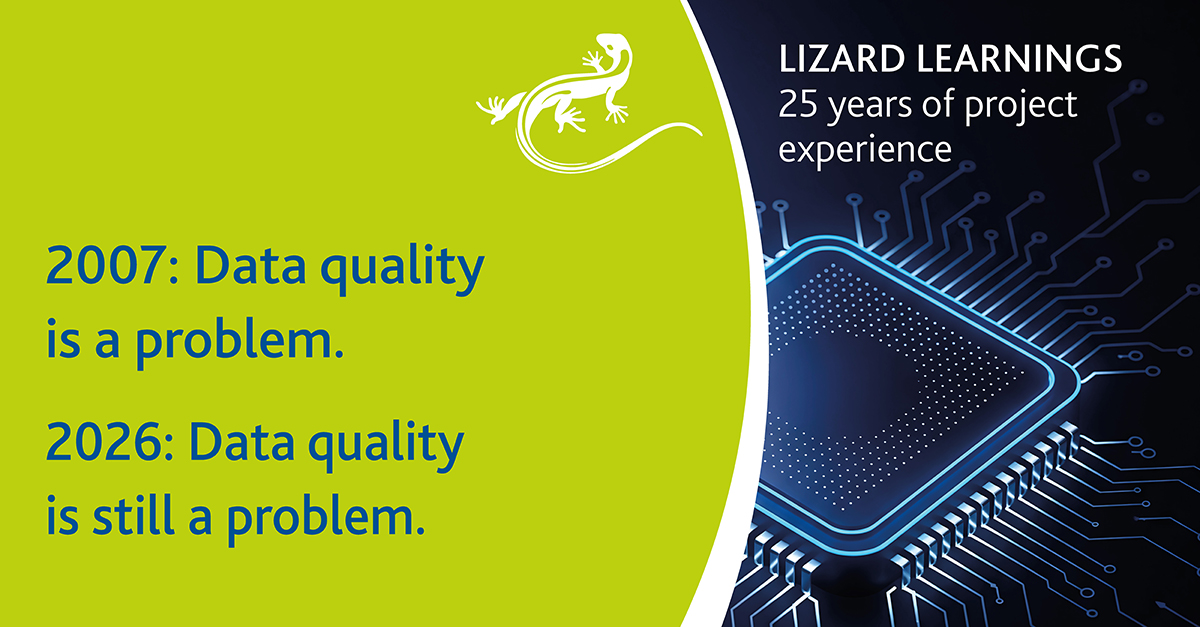
Recently, we pulled an old document from 2007 out of our archive. One sentence stood out immediately: “Millions of francs are lost every day due to poor data quality.”
It was not about major failures. It was about everyday reality. Customers are recorded multiple times, products are defined slightly differently, purchasing volumes are spread across several suppliers even though they belong together. The consequences are not immediately visible. Discounts are missed because volume remains hidden. Negotiations are based on incomplete information. Decisions rely on figures that tell a different story depending on the system. None of this looks dramatic. That is exactly why it goes unnoticed for so long. Until it becomes clear how much money is tied up in these small inconsistencies.
We still hear the same thing today
Nearly twenty years later, systems are better. ERP, planning and reporting deliver reliable data. We now talk about artificial intelligence that can generate insights at the push of a button. But the underlying issue has not gone away. It has moved. Today, the breaks sit between systems. Data is passed on, enriched and combined until many correct individual values turn into a picture that no longer quite fits.
This also changes how people work. They spend a surprising amount of time collecting, checking and reconciling data. Still today. Even when analyses are created instantly, the results have to be questioned and aligned as long as they do not match. By then, decisions are often already made.
The money is not lost in one go. It disappears gradually. A little every day.
Lizard Learning:
Many companies invest heavily in dashboards and reporting tools. The results look better, but it often remains unclear whether everything actually fits together.
This is not just a master data issue. The same problem shows up where systems are connected. Information is defined or interpreted differently, creating a picture that looks plausible but does not really add up.
Artificial intelligence makes this even more visible. Without a reliable foundation, there is no context for meaningful analysis or automation.
That is why the same sentence still holds true today. And unless something changes, it will likely still be true in 2040.

Master Data Management
New products and AI

Plattform